
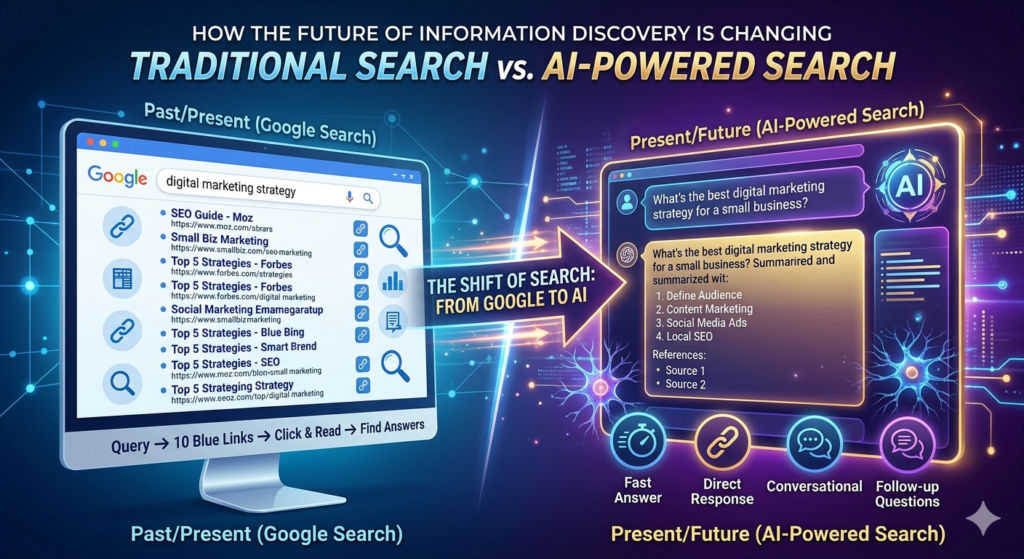
This change marks one of the biggest shifts in the history of the internet: the movement from traditional Google search to AI-powered search.
For more than two decades, Google has been the primary gateway to information on the internet. Whenever people wanted answers, they typed a query into a search engine, clicked through several websites, and found the information they needed. This simple process shaped the digital marketing industry, SEO strategies, and the way businesses built their online presence.
Today, however, a major transformation is taking place. Millions of users are beginning to rely on artificial intelligence tools to answer questions, summarize information, recommend products, and even help make decisions. Instead of browsing through multiple links, users increasingly expect direct, conversational answers.
Why Are People Moving from Google to AI?
Traditional search engines provide users with a list of web pages that may contain the answer. AI-powered platforms work differently. They analyze vast amounts of information and generate a direct response based on the user’s query.
Several factors are driving this shift:
1. Faster Answers
People want instant results. AI can provide a summarized answer within seconds without requiring users to visit multiple websites.
2. Conversational Experience
Instead of using short keywords, users can ask natural questions such as:
- What is the best digital marketing strategy for a small business?
- How can I improve my website traffic in 2026?
- What are the latest SEO trends?
AI understands context and responds in a human-like way.
3. Better Productivity
Students, professionals, marketers, and business owners use AI to research topics, generate ideas, create content, and solve problems more efficiently.
4. Personalized Recommendations
AI can remember context within a conversation and provide recommendations that feel more tailored than traditional search results.
How AI Search Is Changing User Behavior
The way people consume information is evolving rapidly.
Previously, users would:
- Search on Google
- Open multiple tabs
- Compare articles
- Find an answer
Now, many users:
- Ask an AI assistant
- Receive a complete explanation
- Ask follow-up questions
- Get personalized guidance
This creates a smoother and more interactive experience.
Will Google Disappear?
The simple answer is no.
Google remains one of the world’s largest search platforms and continues to process billions of searches every day. In fact, Google itself is investing heavily in artificial intelligence and integrating AI-generated answers into its own search experience.
Rather than disappearing, Google is evolving.
The future will likely combine traditional search with AI-powered assistance, giving users both direct answers and access to trusted sources.
What Does This Mean for SEO?
The rise of AI search is transforming search engine optimization.
Traditional SEO focused mainly on ranking high in Google search results. Modern SEO must also consider how AI systems discover, understand, and reference online content.
Businesses should focus on:
Create High-Quality Content
AI systems prioritize valuable, informative, and trustworthy content.
Answer User Questions
Content should directly answer common questions that people ask online.
Build Authority
Publishing expert articles, case studies, and original insights helps establish credibility.
Improve User Experience
Fast-loading websites, mobile-friendly design, and clear navigation remain essential.
Use Natural Language
People interact with AI conversationally, so content should sound natural and address real user intent.
The Impact on Digital Marketing
The shift from Google to AI affects nearly every aspect of digital marketing.
Content Marketing
Brands must create deeper, more valuable content instead of simply targeting keywords.
Social Media Marketing
AI tools can help generate ideas, analyze trends, and optimize campaigns.
Customer Service
AI chatbots provide instant support and improve customer satisfaction.
Advertising
AI enables smarter targeting, campaign optimization, and performance analysis.
Brand Visibility
Companies need to establish authority across websites, social platforms, and digital channels to remain discoverable.
Opportunities for Businesses
The AI revolution is not just a challenge—it is also a major opportunity.
Businesses that adapt early can:
- Reach new audiences
- Improve customer engagement
- Increase productivity
- Create better content
- Make faster marketing decisions
- Build stronger online authority
Companies that ignore AI may struggle to remain competitive as user behavior changes.
How to Prepare for the Future of Search
To stay ahead, businesses should adopt a future-focused digital strategy.
Invest in Quality Content
Create articles that educate, solve problems, and provide real value.
Focus on Expertise
Share industry knowledge and practical experience.
Optimize for AI and Search Engines
Write naturally while maintaining strong SEO fundamentals.
Build Trust
Display accurate information, maintain transparency, and create authentic content.
Embrace AI Tools
Use AI to improve research, content planning, customer support, and marketing operations.
Challenges of AI Search
Despite its advantages, AI search also presents challenges.
Information Accuracy
AI-generated responses depend on available data and may occasionally contain errors.
Reduced Website Traffic
If users receive answers directly from AI, some websites may experience fewer clicks.
Increased Competition
As AI makes content creation easier, standing out with original, high-quality content becomes more important.
Trust and Transparency
Users still value reliable sources and expert opinions, making credibility a key competitive advantage.
The Future of Search
The future is unlikely to be a choice between Google or AI. Instead, both technologies will work together to create a more intelligent search experience.
Users will expect:
- Instant answers
- Personalized recommendations
- Interactive conversations
- Reliable information
- Seamless digital experiences
Businesses and marketers who understand these changes will be better positioned for long-term success.
Conclusion
The shift of search from Google to AI represents a fundamental change in how people discover and consume information. Artificial intelligence is making search faster, more conversational, and more personalized than ever before.
For businesses, marketers, and content creators, this evolution creates new opportunities to connect with audiences in meaningful ways. Success will no longer depend solely on ranking for keywords but also on creating valuable, trustworthy, and user-focused content that both people and AI systems can understand.
The future of digital visibility belongs to brands that embrace innovation, adapt to changing technology, and continue to deliver genuine value. As AI becomes a central part of everyday life, the organizations that evolve with it will lead the next generation of online search.
Frequently Asked Questions
Is AI replacing Google Search?
No. AI is changing how people search, but Google continues to evolve by integrating AI into its own search platform.
Why are users choosing AI for search?
AI offers faster answers, conversational interactions, and personalized assistance.
How does AI affect SEO?
SEO is becoming more focused on quality content, user intent, authority, and natural language.
What should businesses do to stay visible?
Create helpful content, build expertise, optimize for both search engines and AI platforms, and focus on delivering real value to users.